
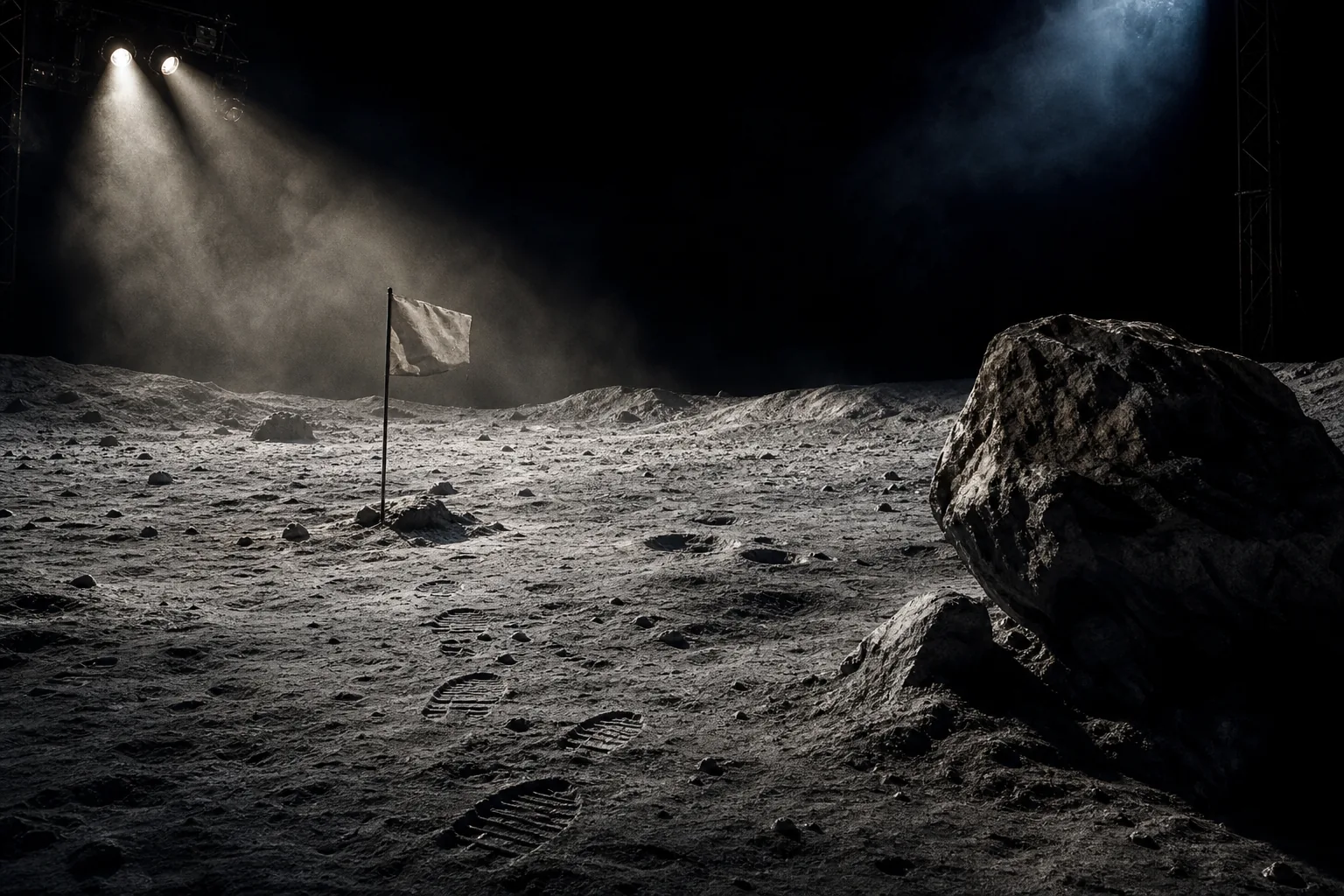
On 20 July 1969, an estimated six hundred million people watched Neil Armstrong step onto the surface of the Moon. It remains one of humanity’s greatest achievements. And yet, almost from the moment it happened, a persistent group of skeptics has insisted the whole thing was staged. Today we examine their arguments one by one.
Why People Doubt
The hoax theory took hold in the 1970s, helped along by a self published book and later by a wave of television specials. The reasoning behind it is partly emotional and partly political. The space race was a Cold War contest, and some argue the United States simply had to win it, by faking the result if necessary. Throw in general distrust of government and the staggering difficulty of the feat, and the seed was planted.
It is worth saying up front that the evidence for the landings is overwhelming. But the doubters raise specific points, and the fun is in working through them.
The Waving Flag
Perhaps the most famous argument concerns the American flag, which appears to ripple in the footage. There is no air on the Moon, the skeptics say, so what is making it wave? The answer is that the flag was not waving in a breeze at all. It was fitted with a horizontal rod to hold it out, and the rippling came from the astronauts twisting the pole as they planted it. With no air to dampen the motion, the disturbance simply lingered longer than it would on Earth.
Where Are the Stars?
Another popular point is the absence of stars in the black lunar sky. Surely, the argument goes, space should be full of them. The explanation is basic photography. The lunar surface was brilliantly lit by the Sun, and the astronauts and their bright suits were the subjects of the shots. Camera settings tuned for those bright objects use fast exposures that are far too quick to capture faint, distant starlight. Any photographer who has tried to shoot stars next to a streetlight knows the effect.
The Strange Shadows
Skeptics also point to shadows that seem to fall in different directions, claiming this proves multiple studio lights were used. In reality, the Moon’s surface is far from flat. It is covered in slopes, craters, and rocks, and uneven ground will bend a shadow in ways that look odd to an eye expecting a smooth floor. The single light source, the Sun, is entirely consistent with what we see once the terrain is taken into account.
The Evidence That Settles It
Beyond debunking individual claims, there is positive proof that is hard to argue with. The Apollo missions brought back roughly 380 kilograms of Moon rock, samples whose chemistry differs from anything on Earth and which scientists worldwide have studied for decades. The astronauts left mirror like reflectors on the surface, and to this day laboratories on Earth bounce lasers off them to measure the distance to the Moon with extraordinary precision.
Then there is the sheer scale of the deception that would be required. Around four hundred thousand people worked on the Apollo programme. For the hoax theory to hold, every one of them would have needed to keep the secret for over fifty years, including engineers in a rival superpower, the Soviet Union, who were tracking the missions closely and had every reason to expose a fake.
Our Verdict
The Moon landing hoax is a case study in how individually puzzling details can feel convincing until each one is examined. Every classic argument, the flag, the stars, the shadows, has a straightforward answer rooted in physics and photography. The mountain of physical evidence, combined with the impossibility of silencing so many witnesses, leaves very little room for doubt.
We landed on the Moon. The achievement is real, and in our view it is far more astonishing than any conspiracy could ever be.