
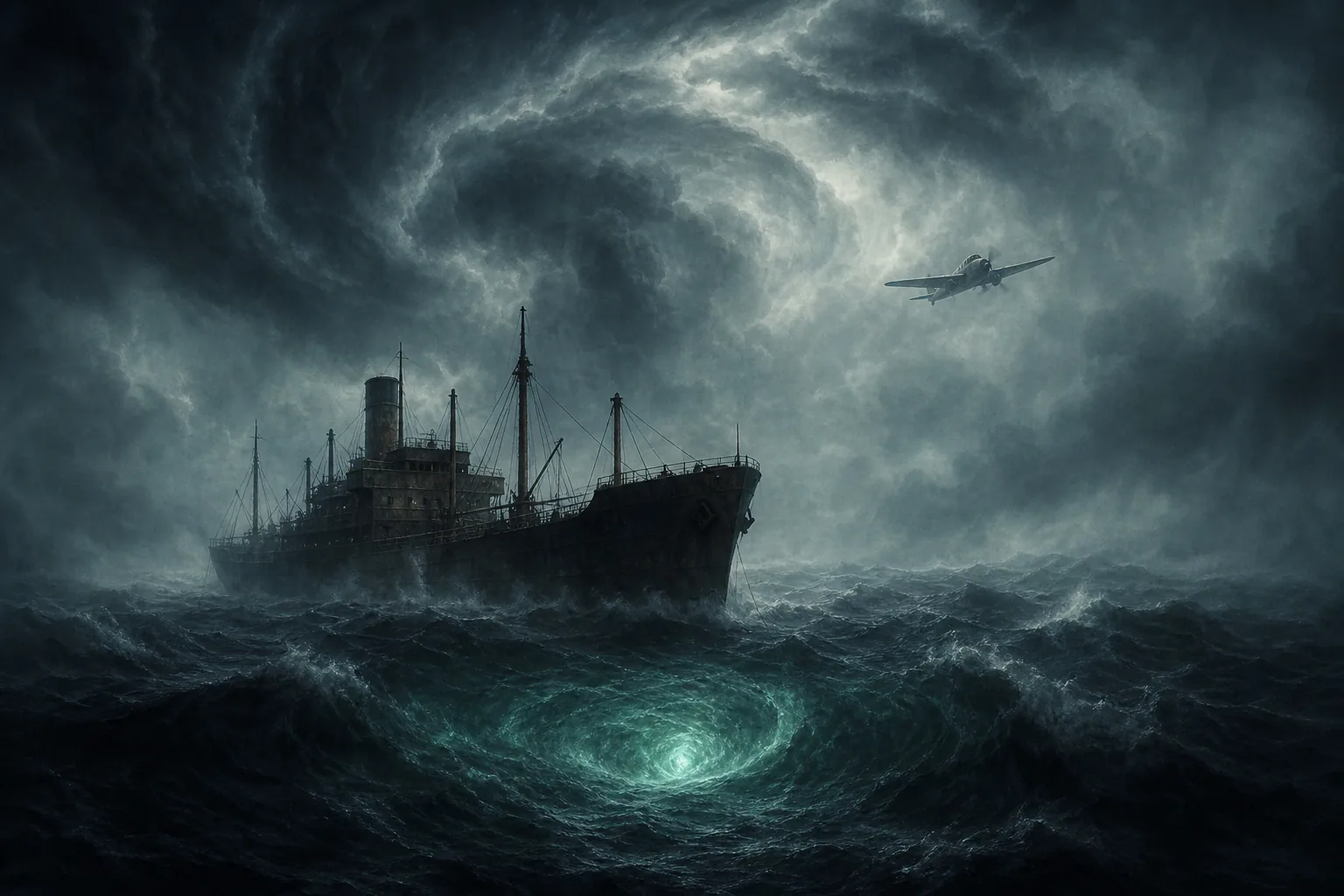
Few places on Earth have captured the imagination quite like the Bermuda Triangle. This stretch of ocean, loosely drawn between Miami, Bermuda, and Puerto Rico, has been blamed for the disappearance of dozens of ships and aircraft over the decades. Today we want to take a closer look at the legend and weigh the theories that try to explain it.
How the Legend Began
The idea of a cursed triangle is surprisingly modern. While sailors had told stories about the area for centuries, the phrase “Bermuda Triangle” only entered popular culture in 1964, when writer Vincent Gaddis used it in a magazine article. A handful of bestselling books in the 1970s did the rest, turning a vague region of the Atlantic into one of the most famous mysteries in the world.
The case that truly cemented the legend was the loss of Flight 19, a squadron of five US Navy bombers that vanished during a training exercise in December 1945. The rescue plane sent to find them disappeared too. To this day, no definitive wreckage has ever been firmly tied to the flight, and that single fact has fed decades of speculation.
The Supernatural Theories
The most colourful explanations reach well beyond the ordinary. Some believers point to the lost city of Atlantis, suggesting that ancient energy crystals resting on the seabed interfere with instruments and pull vessels under. Others tie the region to extraterrestrial activity, arguing that the triangle is a kind of harvesting ground where craft and crews are taken.
A third group leans on the idea of portals or rifts in space and time. According to this view, the disappearances are not deaths at all but vanishings into another dimension. There is, of course, no evidence for any of this, but the absence of clear answers has always left room for the imagination to run.
The Scientific Explanations
Researchers who have studied the region offer far more grounded ideas. One popular theory involves methane hydrates, large pockets of gas trapped beneath the ocean floor. If a pocket suddenly releases, the water can become so full of bubbles that it loses buoyancy, and a ship could sink almost instantly. Laboratory tests have shown the effect is real, though whether it has ever claimed a vessel in the triangle is unproven.
Other scientists point to rogue waves, walls of water that can reach a hundred feet and appear with little warning. The Atlantic here is also home to the Gulf Stream, a powerful current that can scatter wreckage and erase evidence within hours. Add sudden storms, magnetic quirks that can confuse compasses, and simple human error, and you have a recipe for losses that need no curse to explain them.
Is the Triangle Really That Deadly?
Here is the detail that rarely makes it into the documentaries. When insurers and coast guard agencies have looked at the numbers, they have found that the Bermuda Triangle is no more dangerous than any other heavily travelled patch of ocean. Lloyd’s of London, the famous insurance market, has stated that the area does not warrant higher premiums.
The triangle sits along some of the busiest shipping and flight routes in the world, and it endures frequent tropical storms. More traffic and more bad weather naturally produce more incidents. When you account for the sheer volume of vessels passing through, the rate of loss looks ordinary.
Our Verdict
The Bermuda Triangle is a perfect example of how a few dramatic cases, a catchy name, and a string of bestselling books can turn a stretch of ordinary ocean into a global legend. The science offers plenty of mundane culprits, from gas pockets to rogue waves to plain bad luck.
Still, we understand the appeal. As long as there are unexplained gaps in the record, like the missing wreckage of Flight 19, the stories will keep being told. And honestly, that mystery is half the fun.